
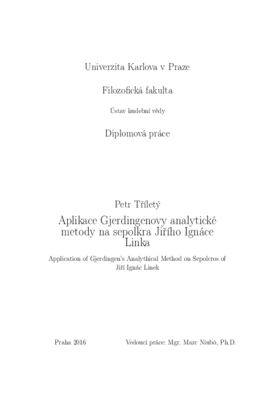
Analýza sepolker Jiřího Ignáce Linka
The analysis of sepolcri by Jiří Ignác Linek
diplomová práce (OBHÁJENO)
Zobrazit/
Trvalý odkaz
http://hdl.handle.net/20.500.11956/84315Identifikátory
SIS: 154635
Katalog UK: 990021107090106986
Kolekce
- Kvalifikační práce [25347]
Fakulta / součást
Filozofická fakulta
Obor
Hudební věda
Katedra / ústav / klinika
Ústav hudební vědy
Datum obhajoby
6. 9. 2016
Nakladatel
Univerzita Karlova, Filozofická fakultaJazyk
Čeština
Známka
Výborně
Klíčová slova (česky)
hudební analýza, oratorium, sepolkro, Gjerdingen, galantní styl, Čechy, 18. stoletíKlíčová slova (anglicky)
music analysis, Gjerdingen, the galant style, oratorio, Bohemia, 18th century, sepolcroAutor předkládané práce si klade za úkol prověřit použitelnost konceptu galantního stylu, jak je představen v pojednání Roberta Gjerdingena, Music in the Galant Style, 2007. Za hudební materiál, jejž se chce pokusit pomocí zmíněného konceptu analyzovat, si vybírá tři dochovaná sepolkra bakovského kantora Jiřího Ignáce Linka (1725- 1791). Důkladněji se zabývá též diplomovou prací Evy Tomandlové (1934-2010) z konce padesátých let, jejímž tématem byla řečená sepolkra. Při představování Gjerdingenova přístupu a jeho specifických možností si tak může vypomoci jeho porovnáním s metodou, kterou lze považovat za reprezentanta převládající analytické tradice. Powered by TCPDF (www.tcpdf.org)
The author of the thesis wants to examine the applicability of the concept of galant style as presented by Robert Gjerdingen in his treatise Music in the Galant Style (2007). As a musical material which he wants to analyze by using the mentioned concept he chooses three extant sepolcros by a schoolmaster from Bakov nad Jizerou Jiří Ignác Linek (1725-1791). Further, he deals with a thesis by Eva Tomandlová (1934- 2010) written in the late 1950's that had these sepolcros as its subject. Thus, at presenting Gjerdingen's approach and its specific possibilities, the author can make use of comparison with a method which can be considered an exemplar of the prevailing analytical tradition. Powered by TCPDF (www.tcpdf.org)